Top China Bicycle Front Suspension Manufacturers?
Choosing among Top China Bicycle Front Suspension Manufacturers requires more than comparing prices or polished product photos. A dependable supplier must demonstrate engineering depth, consistent production, meaningful testing, and transparent communication. This introduction examines manufacturers through practical criteria, including fork architecture, damping control, stanchion treatment, crown strength, axle standards, and long-term service support.
Paul Turner, RockShox co-founder and a respected suspension engineer, is often associated with the practical principle, “The tire is the suspension.” That idea remains useful. A Bicycle Front Suspension system only performs well when it keeps the tire controlled across roots, gravel, braking zones, and uneven urban surfaces. Factory claims still need verification. Look for compression and rebound data, fatigue-test records, material specifications, and evidence from independent riders or bicycle brands.
Details matter. A well-designed fork should move smoothly at low speed, resist bottoming during hard impacts, and remain predictable when braking. Seals should not collect visible dust after a short ride. The arch should feel rigid, not vague. These signs reveal more than advertising language.
There is no perfect shortlist. Some manufacturers offer excellent machining but limited aftermarket support. Others provide strong customization but uneven quality between production batches. That weakness deserves attention. Therefore, this guide considers technical capability, quality-control systems, export experience, warranty responsiveness, and real-world application. The strongest candidates are not simply the largest factories. They are manufacturers able to explain their design decisions, document their testing, and improve when field feedback exposes a problem.
What Bicycle Front Suspension Manufacturers Produce in China?
China’s bicycle front suspension manufacturers produce complete forks and many supporting components.
Their common products include air-sprung forks, coil-sprung forks, and hybrid systems for mountain, gravel, and electric bicycles. Travel options often range from short urban comfort settings to longer off-road configurations. Some factories also make rigid forks, steerer tubes, crowns, lowers, dropouts, and thru-axle assemblies.
Production normally combines aluminum machining, magnesium casting, steel treatment, and controlled assembly.
Suppliers may offer mechanical or hydraulic damping, adjustable rebound, compression controls, and handlebar lockouts. Air chambers require careful sealing around the piston and valve. Small errors can cause pressure loss. Manufacturers therefore inspect surface finish, alignment, axle fit, travel distance, and braking mounts before shipment.
Experienced buyers should request test records, material specifications, fatigue results, and sample inspections. A reliable manufacturer can explain its tolerance limits, coating process, and replacement-part support without vague promises. Factory capacity also matters, especially when custom travel, steerer length, or axle spacing is required. Not every polished sample survives field use. That gap deserves attention. Independent testing may reveal noise, stiction, or inconsistent damping after repeated impacts. A practical sourcing decision should balance price, engineering control, quality consistency, and after-sales responsiveness.
How to Evaluate China’s Leading Suspension Fork Manufacturers
Top China Bicycle Front Suspension Manufacturers?
Evaluating China’s leading suspension fork manufacturers requires more than comparing catalog prices. Check their engineering depth, production control, and testing records. A capable factory should explain alloy selection, steerer-tube strength, damping settings, and fatigue-test procedures clearly. Vague answers deserve caution.
Request samples from different production batches. Inspect welds, axle alignment, rebound adjustment, coating thickness, and seals under dusty conditions. Ask for material certificates, inspection reports, and traceability records. Confirm whether testing follows recognized bicycle safety standards. Factory visits can reveal details that documents hide, such as crowded assembly areas or poorly protected components. Communication matters too. Engineers should respond with measurements, not marketing phrases.
Tips: Compare at least three suppliers. Test samples before signing large orders. Clarify minimum quantities, replacement parts, warranty handling, and delivery tolerance. Ask how failed forks are investigated. A serious manufacturer will describe corrective actions. Do not judge quality from a polished showroom. I have seen impressive samples followed by inconsistent bulk production. That risk is easy to underestimate. A smaller supplier may offer closer engineering support, while a larger one may provide stronger capacity. Neither advantage is automatic. Recheck every assumption.
Top China Bicycle Front Suspension Manufacturers? How to Evaluate China’s Leading Suspension Fork Manufacturers
Representative front suspension fork travel benchmarks by bicycle category
Suspension fork travel is a practical specification for comparing product portfolios. Cross-country forks commonly use about 100–120 mm of travel, trail forks about 130–150 mm, enduro forks about 160–180 mm, and downhill forks about 180–203 mm. When evaluating manufacturers, check whether their product range matches these established use-case requirements, along with damping performance, axle standards, steerer design, testing capability, and after-sales support.
Top China Bicycle Front Suspension Manufacturers by Product Focus
Top China Bicycle Front Suspension Manufacturers by Product Focus
China’s leading bicycle suspension manufacturers usually specialize by product focus, not by one universal design. For cross-country bikes, factories often develop lightweight air forks with magnesium lowers, remote lockouts, and adjustable rebound. Trail-focused suppliers offer stronger chassis, longer travel, and thicker stanchions. These products suit rocky paths and repeated impacts.
E-bike suspension requires a different approach. Heavy-duty manufacturers reinforce steerer tubes, crowns, and axles to manage higher system weight. Urban suppliers may prioritize short travel, simple maintenance, and corrosion-resistant finishes. Some factories also produce children’s forks and OEM components, but quality can vary sharply. A polished catalog is not enough. Ask for fatigue-test records, dimensional reports, coating checks, and samples from current production. Compliance with applicable bicycle safety standards should be verified independently.
Tips: Match the fork to rider weight, wheel size, travel, and braking load. Request test samples before placing a large order. Check rebound control in cold and wet conditions. Small details matter. A supplier may promise customization, yet lack stable tooling or replacement-part support. That weakness can become expensive after launch. I would also compare actual sample weight against the specification, because small differences often reveal inconsistent production control.
Key Technologies Used in Modern Bicycle Front Suspension
Modern bicycle front suspension relies on controlled movement, not simply a soft spring.
In factory testing, engineers measure sag, rebound speed, and stiffness under repeated impacts. A coil spring offers predictable support and works well in muddy conditions. An air spring reduces weight and allows precise pressure adjustment. It can feel less consistent when seals become dry. That detail matters. Many Chinese suspension manufacturers now use CNC-machined crowns, forged lowers, and sealed cartridge dampers. These processes improve alignment and reduce unwanted friction. Still, machining accuracy alone cannot guarantee a comfortable ride.
Hydraulic damping is the main technology controlling fork movement.
Oil passes through calibrated ports and shims inside the cartridge. Low-speed compression supports braking, while high-speed control manages sharp rocks and roots. Rebound damping prevents the fork from bouncing after compression. Riders often overlook this setting. A fork may feel harsh because rebound is too slow, not because the spring is too firm. Dust wipers, bushings, and anodized stanchions also affect durability. During service checks, technicians inspect oil contamination and side play. Small wear can become obvious on rough trails.
Modern designs increasingly use lightweight magnesium lowers and tapered steerer tubes.
These parts improve strength without adding unnecessary mass. Remote lockout systems help on smooth climbs, though cables can require frequent adjustment. Electronic control is developing, but it remains expensive and less repairable in remote areas. That is a real limitation. Reliable manufacturers publish torque values, service intervals, and laboratory test data. They should also explain cold-weather performance and seal replacement procedures. Certification is useful, but transparent testing gives buyers more confidence. I would still question any claim based only on peak stiffness figures. Real riding includes braking bumps, wet trails, and imperfect maintenance.
How to Select and Source a Reliable Chinese Manufacturer
Selecting a reliable Chinese bicycle front suspension manufacturer requires more than comparing online quotations. Study the factory’s actual production capability, engineering team, and quality records. A professional supplier should explain suspension travel, spring rates, damping control, axle standards, crown design, and seal protection clearly. Vague answers deserve caution.
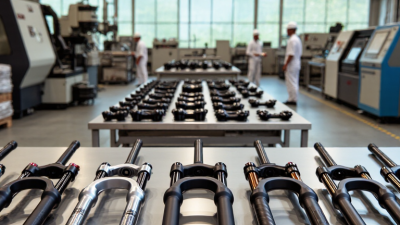
Request detailed drawings, material specifications, tolerance ranges, and a complete bill of materials. Ask whether critical parts are machined internally or purchased from outside vendors. A factory video call can reveal useful details: assembly benches, cleanliness, measurement tools, and finished fork storage. Visit the facility when possible. Photos are not enough.
Begin with a paid sample and test it under realistic conditions. Check steering play, rebound consistency, surface finish, corrosion resistance, and performance after repeated compression cycles. Require documented inspection points and agree on acceptable limits before production. Independent inspection can reduce surprises before shipment. Keep communication written, especially for design changes and packaging requirements.
A small pilot order is safer than a large first purchase. Track defects by batch, not by memory. Some suppliers appear capable during sampling but struggle with volume control. I have learned that fast replies do not always mean strong engineering. Ask difficult questions twice. Compare the answers. A dependable manufacturer accepts reasonable scrutiny, reports problems early, and improves the process instead of hiding imperfections.