Leave Your Message
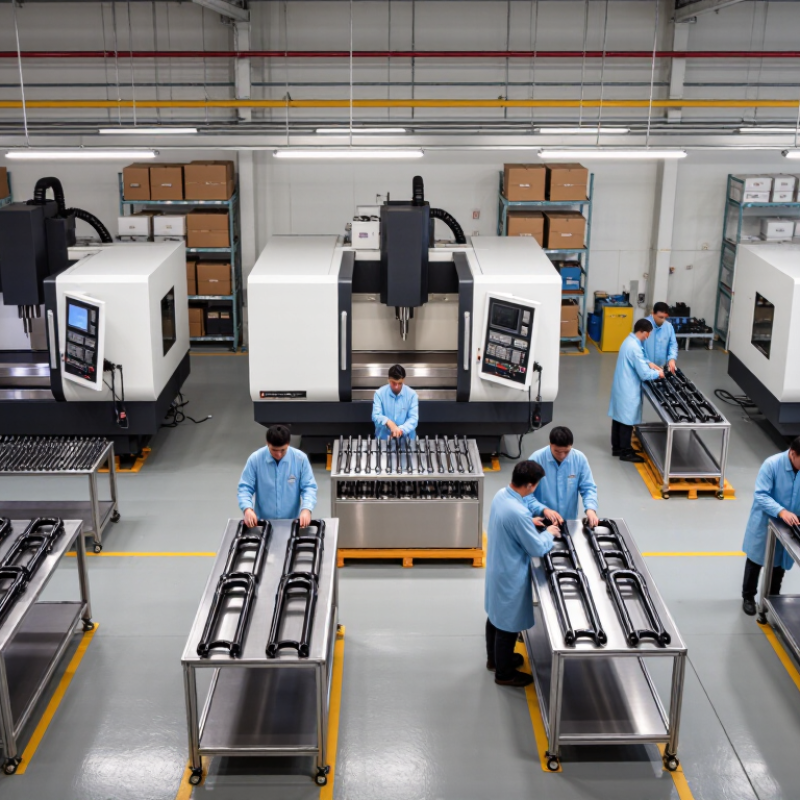
China’s Dual Crown Fork manufacturing sector has grown from basic metal processing into a highly specialized engineering field. Today, leading suppliers combine CNC machining, forging, heat treatment, suspension tuning, and controlled assembly. Their products serve downhill bikes, freeride platforms, racing prototypes, and demanding OEM programs.
Paul Turner, founder of RockShox, once summarized suspension development with a practical principle: “Make the suspension work, then make it reliable.” That idea remains relevant when evaluating China’s top Dual Crown Fork manufacturers. A strong supplier should provide accurate steerer alignment, consistent crown strength, dependable seals, and traceable quality inspections. Factory photographs are useful. Test records matter more.
This overview examines ten notable Chinese manufacturers through a buyer’s lens. It considers production experience, engineering capability, material control, testing procedures, customization support, and after-sales communication. Details can reveal a lot: a clean anodized surface, even bolt torque, smooth stanchion movement, and carefully protected packaging.
Not every factory deserves the same confidence.
Some companies present impressive catalogs but offer limited test evidence. Others may produce excellent components while communicating poorly. That weakness should not be ignored. A ranking can guide research, but it cannot replace sample inspection, technical verification, and direct supplier dialogue. Buyers should confirm axle standards, steerer dimensions, travel options, damping specifications, warranty terms, and applicable safety requirements before placing an order. The best manufacturer is not always the largest. It is the one that consistently turns precise engineering into reliable performance on the trail.
China Top 10 Dual Crown Fork Manufacturers
What Dual Crown Forks Are and How They Work
A dual crown fork uses two crowns to connect its legs to the steerer tube. One crown sits above the head tube, while the other sits below it. Together, they hold the stanchions more firmly and reduce twisting during hard landings or sharp turns. The axle, lowers, springs, and damping cartridges manage wheel movement. Compression damping controls how quickly the fork moves inward. Rebound damping controls how fast it returns. This structure is common on downhill bicycles, where steering precision and impact control matter greatly. It is strong, but not light.
In workshop practice, correct setup affects performance more than appearance. Riders should match air pressure or spring rate to body weight, riding speed, and terrain. Too much compression can make roots feel harsh. Too little rebound control may cause repeated bouncing. A dual crown fork also needs enough frame clearance through its steering range. A common mistake is adjusting only pressure. Seals, bushings, bolts, and the steerer area also require regular inspection. The design is not automatically better for every bicycle. It may limit frame compatibility and change handling noticeably.
Tips: Check torque values with a calibrated wrench. Keep the stanchions clean and lightly lubricated. Record each adjustment before changing another setting. If steering feels sticky, stop riding and inspect it. Some problems appear small, but they can worsen quickly.
Technical comparison of representative dual-crown fork configurations and their operating characteristics
| No. | Typical Configuration | Typical Travel | Stanchion Diameter | Crown Structure | How It Works | Spring and Damping | Typical Application |
|---|---|---|---|---|---|---|---|
| 1 | Downhill Racing Fork | 180–203 mm | 35–40 mm | Upper and lower crowns | The two crowns clamp the upper tubes at separate points, increasing steering stiffness and reducing fore-aft flex during hard braking and landing impacts. | Usually an air spring or coil spring with adjustable compression and rebound damping. | Gravity racing, bike parks, steep downhill trails, and large jumps. |
| 2 | Freeride Fork | 180–200 mm | 35–40 mm | Reinforced dual crown | The crowns distribute bending loads over a longer section of the steerer and upper tubes, helping the fork remain aligned after repeated heavy impacts. | Air or coil spring; damping circuits commonly include low-speed compression and rebound adjustment. | Freeride courses, technical descents, drops, and jump-focused riding. |
| 3 | Long-Travel Enduro Fork | 170–180 mm | 35–38 mm | Compact dual crown | The upper crown improves torsional control while the long-travel chassis absorbs repeated rock, root, and step-down impacts. | Primarily air spring with adjustable air pressure, volume spacers, compression, and rebound damping. | Aggressive enduro, alpine trails, and riders prioritizing downhill control. |
| 4 | Heavy-Duty E-MTB Fork | 170–200 mm | 38–40 mm | Load-rated dual crown | The additional crown helps control steering loads created by higher system weight, stronger braking, and increased momentum from an electric powertrain. | Air spring is common; damping is tuned for higher combined rider, bicycle, and cargo loads. | High-power electric mountain bicycles and heavy-duty trail use. |
| 5 | Coil-Spring Gravity Fork | 180–203 mm | 35–40 mm | Upper and lower crowns | A metal coil compresses as the fork moves upward, while oil passing through calibrated valves controls compression and rebound speed. | Coil spring with preload adjustment; hydraulic compression and rebound circuits. | Long descents, frequent high-speed impacts, and riders seeking consistent small-bump sensitivity. |
| 6 | Air-Spring Gravity Fork | 180–203 mm | 35–40 mm | Lightweight dual crown | Pressurized air provides the spring force. Changing air pressure and volume changes sag, progression, and bottom-out resistance. | Adjustable air spring with hydraulic compression and rebound damping. | Riders who need lower weight and broad setup adjustability for gravity riding. |
| 7 | Tandem or Cargo Bicycle Fork | 120–160 mm | 32–38 mm | Load-reinforced dual crown | The two crowns increase lateral and torsional stiffness, which helps maintain tracking when the front wheel carries a high or uneven load. | Air or coil spring selected according to the approved system weight; hydraulic damping is recommended. | Tandems, cargo bicycles, and specialized utility bicycles. |
| 8 | Small-Wheel Gravity Fork | 100–150 mm | 28–35 mm | Short dual crown | A shorter chassis combines dual-crown stiffness with reduced axle-to-crown height for compact frames and smaller wheels. | Air or coil spring with basic compression and rebound control. | Compact gravity bicycles, youth downhill bicycles, and specialized small-wheel builds. |
| 9 | Prototype or Custom Chassis Fork | 140–200 mm | 32–40 mm | Application-specific dual crown | The crown spacing, steerer length, offset, and axle height are selected to match the frame geometry and the intended load case. | Spring and damping hardware are configured according to testing requirements and target rider weight. | Engineering validation, custom frames, and limited-production bicycles. |
| 10 | Race-Tuned Competition Fork | 180–203 mm | 35–40 mm | High-stiffness dual crown | The rigid crown assembly keeps the front wheel accurately aligned while the damper manages energy from braking, compression, and rebound events. | Low-friction air or coil spring with independently adjustable hydraulic damping circuits. | Professional-level downhill and gravity competition where steering precision is critical. |
Note: Travel, tube diameter, axle standard, offset, and maximum system weight must be confirmed against the specific frame, wheel, and fork design. The ranges above are representative technical values rather than product specifications.